For several years, the meat sold in supermarkets has been receiving increasing attention from consumers and agricultural organizations. At Lidl, a German brand that has established a significant presence in France, the issue of traceability frequently arises, fueled by laboratory tests, union inspections in stores, and analyses by dieticians published online.
Actual composition of Lidl ground beef: what the labels reveal
Discussions surrounding Lidl meat often focus on the trays of ground beef. A senior dietetics technician, Miodrag Borges (creator of the account “microbiotadesdecero”), analyzed several references sold under the “Origine Pyrénées / Origin Prineos” brand. His findings vary depending on the type of product.
The organic ground meat from this range displays a short composition, without additives or preservatives. The product contains only beef and salt, which complies with the European organic standards that prohibit additives in fresh ground meat.
In contrast, prepared ground beef (such as burgers) has a longer ingredient list. It includes vegetable fibers, soy proteins, and sometimes flavorings. This is not illegal, but it changes the nature of the product: it is no longer pure ground meat, but a meat-based preparation. To understand the origin of the meat at Lidl, carefully reading the label remains the most reliable action.
The distinction between “ground meat” and “ground meat preparation” escapes most buyers. The legal designation, often printed in small print under the commercial name, is the only reliable regulatory indicator.

Store inspections by farmers: the results for Lidl
In March 2026, farmers from the FDSEA and Young Farmers of Lot conducted inspections in several supermarkets in the department, including Lidl stores in Figeac, Cahors, and Saint-Céré. The goal was to verify whether the origin of the meats sold corresponded to French production.
Lidl received a “yellow card” during these inspections. Farmers noted foreign-origin meats on the shelves, without clear information being provided to the consumer. A similar action had already taken place in Mayenne, where the FDSEA-JA 53 network removed many foreign-origin products from the shelves of a Lidl store in Saint-Berthevin.
These operations are not official inspections in the regulatory sense. They rely on the reading of labels and origin mentions by the farmers themselves. Their scope remains limited to a given moment, in a specific store. Field reports vary on this point: some Lidl stores display a majority of French meat, while others have a more mixed supply.
Laboratory tests: merguez, undeclared water, and cross-contaminated DNA
Traceability is not limited to the country of origin. It also concerns the actual composition of the product compared to what is advertised. Two types of documented issues deserve attention.
A test published by 60 Millions de consommateurs on supermarket merguez highlighted, for certain references sold at Lidl:
- Prohibited vegetable fibers in the composition, whereas regulations do not allow them in merguez
- Fragments of bone and cartilage, indicating insufficient cutting or sorting of raw materials
- Traces of pork or sheep DNA in products supposed to be single-species, which raises a control issue in the manufacturing chains among suppliers
In Germany, independent tests conducted in 2024 on ground meats from retailers, including Lidl (Landjunker brand), revealed a second type of defect: undeclared water additions in certain retail meat products. This phenomenon, observed across several brands, indicates that traceability goes beyond just geographical questions to touch on transparency regarding composition.
European regulations and limits of the labeling system
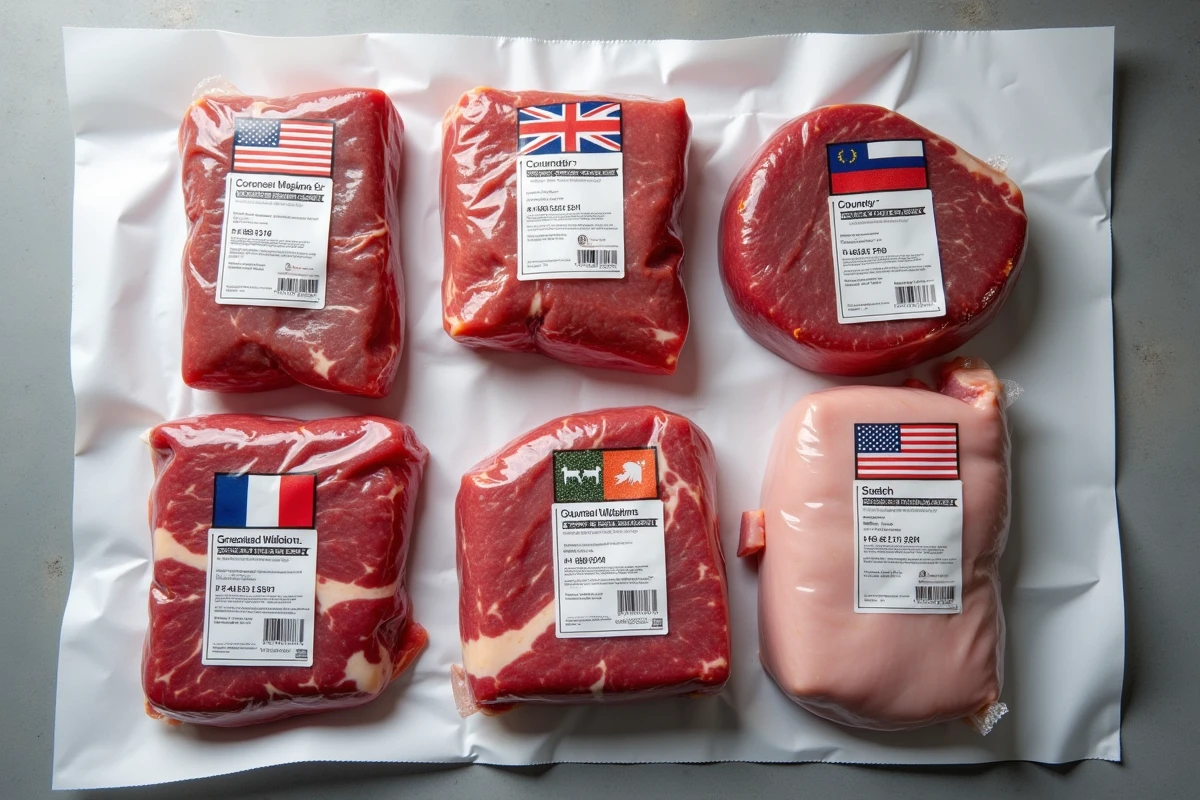
The regulatory framework requires distributors to indicate the country of origin for fresh beef. For pork, poultry, and lamb, the obligation to label the origin has also existed in France for several years, but it does not cover all processed products.
A pure fresh beef burger must mention the place of birth, rearing, and slaughter of the animal. A ground meat preparation (burger, meatball) is not subject to the same requirements. It is in this regulatory gap that gray areas exist.
- Processed products (sausages, merguez, ready meals) do not have a systematic obligation to mention the origin of each meat ingredient
- The mention “made in France” does not mean that the animal was raised in France, only that the processing took place on the territory
- The “Viande de France” logo remains the most reliable marker to guarantee an animal born, raised, slaughtered, and processed in France
The available data does not allow for a conclusion on the exact proportion of French meat in Lidl’s assortment on a national scale. The brand communicates about partnerships with French sectors, but the details by store and period remain opaque.
For consumers, the most useful reflex involves two actions: checking the legal designation of the product (ground meat or preparation) and looking for the “Viande de France” logo or mentions of place of birth, rearing, and slaughter. The absence of these mentions on a package is in itself information.