
12:13 appears on a screen and catches the eye. This combination of digits is neither a classic mirror hour (12:12) nor a standard reversed hour (12:21). In numerology, adding its digits (1 + 2 + 1 + 3) gives 7, a number associated with introspection and inner exploration.
The article below examines the numerical interpretation of this particular time, how it differs from other time formats, and how selective attention offers an additional perspective.
12:13 compared with other time formats: comparison table
Before interpreting 12:13, it helps to place it alongside the categories of times found in esoteric literature. Each format follows a different kind of symmetry, and 12:13 does not fit into any standard category.
| Time type | Symmetry principle | Example | Reduced sum |
|---|---|---|---|
| Mirror hour (double) | The minutes repeat the hours | 12:12 | 1 + 2 + 1 + 2 = 6 |
| Reversed hour | The minutes reverse the hours | 12:21 | 1 + 2 + 2 + 1 = 6 |
| Triple hour | Three identical consecutive digits | 11:12 or 12:22 | Variable |
| 12:13 (offset hour) | No standard symmetry | 12:13 | 1 + 2 + 1 + 3 = 7 |
A one-minute shift from 12:12 changes the numerical sum from 6 to 7. In numerology, this difference is significant: 6 is associated with harmony in relationships, while 7 points toward inner life and analysis.
Those exploring the spiritual meaning of 12:13 in numerology will find this distinction between the two numbers as a starting point for interpretation.
Numerology of 7: what the sum of 12:13 reveals
The most common method is to add each digit in the time until you arrive at a single-digit number. For 12:13, the calculation is 1 + 2 + 1 + 3 = 7. This result points the interpretation in a specific direction.

In numerology, 7 is associated with introspection, the search for meaning, and chosen solitude. This is not forced isolation, but a deliberate turn toward personal reflection.
Three themes recur in interpretations of 7 as applied to times:
- A call to step back from a situation on your mind and take time to reflect before making a decision
- An invitation to explore a spiritual or intellectual dimension that has been neglected in everyday life
- A reminder to trust your own judgment rather than constantly seeking outside validation
Interpretations vary depending on the numerical method used. Some practitioners add the hours separately (1 + 2 = 3) and the minutes (1 + 3 = 4), then interpret the 3/4 pairing as a tension between creative expression and the need for structure. Stating which method you use avoids presenting one interpretation as universal.
Comparing 7 with neighboring numbers
12:12 adds up to 6, the number of emotional balance and responsibility toward loved ones. 12:14 would give 8, associated with material achievement and ambition. The 7 of 12:13 falls between these two poles, in a more contemplative space.
This middle position explains why some interpretive frameworks associate 12:13 with a necessary pause between two active phases.
Selective attention and synchronicity: two ways of interpreting it
The feeling that you keep coming across 12:13 can be explained by a well-documented psychological mechanism. Selective attention makes us more likely to notice things that have already caught our interest, while forgetting the hundreds of other times we check throughout the day.
Once 12:13 has caught your eye, your brain becomes more receptive to this combination. Ordinary times (14:37, 09:52) go unnoticed, while each new appearance of 12:13 reinforces the feeling that it is a sign.
This mechanism does not disprove symbolic interpretations. The two approaches can coexist without contradicting each other:
- The psychological perspective describes how a time becomes more noticeable in everyday perception
- The numerical perspective assigns symbolic value to the digits, regardless of how often they actually appear
- The spiritual perspective holds that paying attention to this time is itself the signal, whatever the cause
No scientific source supports the claim that a particular time predicts a specific event. Numerology serves as a tool for personal reflection, not as a verifiable predictive method.
12:13 in practice: for reflection, not prediction
The distinction between reflection and prediction changes how you use this time. Treating 12:13 as a reminder to make time for introspection falls within the realm of personal development. Expecting an event to happen because you saw 12:13 is a different approach, one that has no basis in the numerological sources consulted.
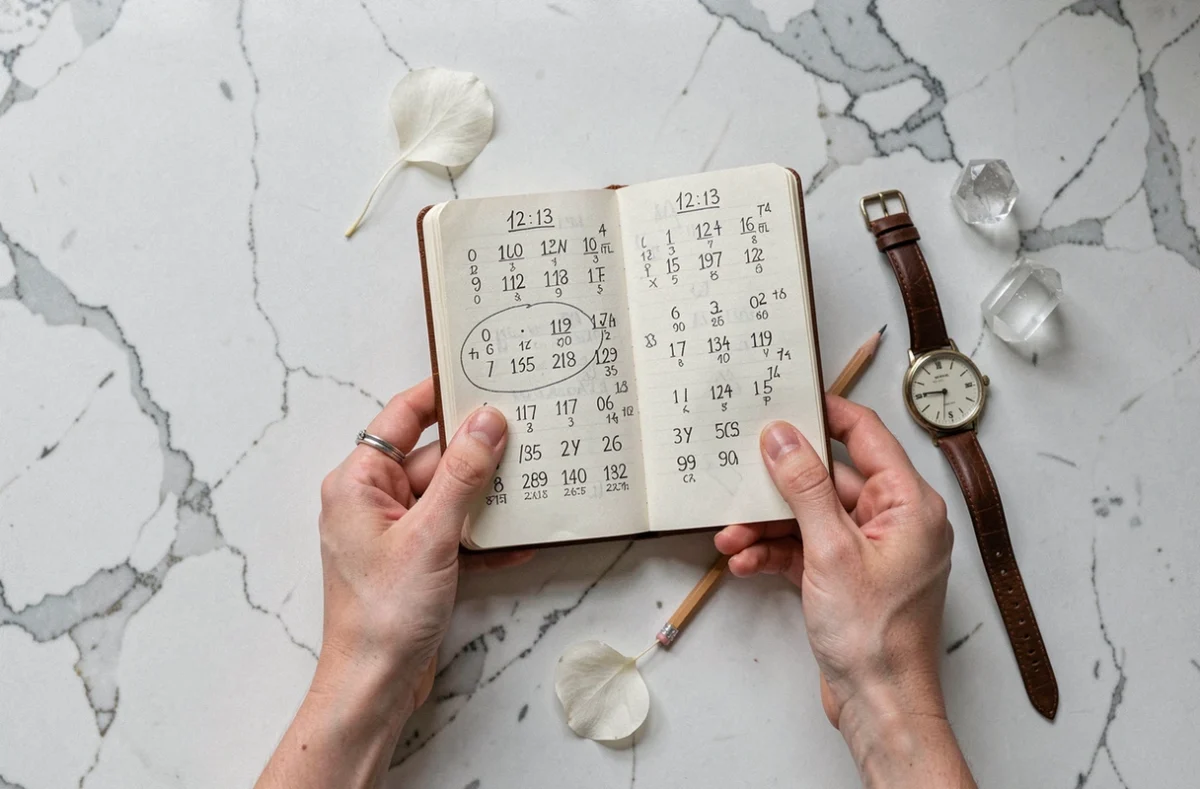
In practice, noting what you were thinking about when you saw 12:13 can help you identify recurring concerns. The number 7 specifically invites this kind of self-observation. The value of the exercise lies in what it reveals about your own priorities, not in any guaranteed message from an outside source.
12:13 remains a time that falls outside the usual classifications. Its lack of symmetry makes it more distinctive than a standard mirror hour, and the sum of 7 it produces points toward analysis rather than immediate action. Whether you use this interpretation as a starting point for personal reflection or simply as a numerical curiosity, it asks only one thing: pay attention to what is on your mind at that precise moment.